


A step down transformer reduces voltage and a step up transformer raises it. That is the whole difference, but which one you need depends on where the appliance came from and where you want to use it. Get it the wrong way round and the appliance either will not run or will be damaged.
This guide explains how each type works, which direction you need for the common country pairs, and how to pick the right size voltage converter for the appliance.
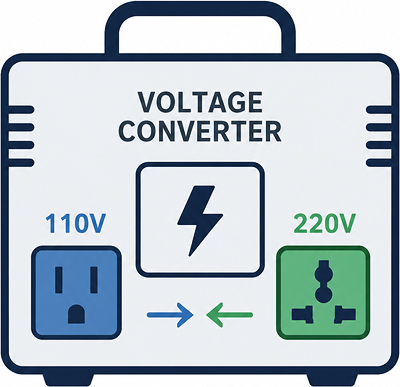
What a voltage converter actually does
A voltage converter is an electric transformer packaged for one job: letting an appliance built for one country's mains run on another country's. Inside is a toroidal transformer with two windings. Mains goes into one winding, the appliance is connected to the other, and the ratio between the windings sets the output voltage. There is no electronics and nothing to go wrong, which is why a well-made transformer will run for decades.
Every converter in the Airlink voltage converter range is wound and built in Britain to BSEN61558-2-13, and every unit over 1kVA has a surge limiter fitted.
Step down transformers: bringing foreign appliances to the UK
UK mains is 230V. American appliances are built for 120V and Japanese appliances for 100V. To use either here you need a step down transformer that takes 230V in and gives 120V or 100V out.
This is the most common converter people buy. Typical uses: a KitchenAid mixer or Vitamix brought over from the US, a Japanese rice cooker, American audio equipment, Japanese games consoles and medical devices.

For US appliances: Use American Appliances in the UK (230V to 120V). For Japanese appliances: Japanese Voltage Converters (230V to 100V).
Step up transformers: taking UK appliances abroad
Going the other way, a UK appliance in America or Japan sees only 120V or 100V at the socket and needs a step up transformer to raise it back to 230V. Without one a kettle will barely warm up and a motor may burn out trying to start.

For UK appliances in the US: Use UK Appliances in America (120V to 230V). For UK appliances in Japan: Use UK Appliances in Japan (100V to 230V). The American and Japanese ranges also cover European appliances in both directions.
Which direction do I need? Quick reference
| Appliance built for | Using it in | You need | Converts |
|---|---|---|---|
| USA / Canada (120V) | UK or Europe | Step down | 230V to 120V |
| Japan (100V) | UK or Europe | Step down | 230V to 100V |
| UK or Europe (230V) | USA / Canada | Step up | 120V to 230V |
| UK or Europe (230V) | Japan | Step up | 100V to 230V |
| USA (120V) | Japan | Step down | 120V to 100V |
| Japan (100V) | USA | Step up | 100V to 120V |
How to size a voltage converter
Find the rating plate on the appliance. It will show the voltage and either watts (W) or volt-amps (VA); for sizing treat them as the same. Pick a converter rated above that figure, not equal to it.
Anything with a motor or heating element draws more at switch-on than its running figure suggests, so give it extra headroom. A 1,500W kettle needs a 2,000VA converter. A laptop charger rated at 90W is fine on a 100VA unit. For appliances that run for hours, such as a fridge or a fan, size more generously again.
| Appliance | Typical rating | Converter to choose |
|---|---|---|
| Laptop / phone charger / games console | 100VA | 100VA |
| Hi-fi / TV / computer | 300VA | 300 to 500VA |
| Hair straighteners / small kitchen gadget | 250 to 450VA | 500VA |
| Stand mixer / blender / vacuum | 750 to 1,000VA | 1,000VA |
| Kettle / rice cooker / large vacuum | 1,400 to 1,500VA | 2,000VA |
| Washing machine / hair dryer | 2,000VA | 2,500 to 3,000VA |
For a full appliance list and notes on heat, ventilation and frequency, see the voltage converter selection guide.
Three things a transformer cannot do
- Change the frequency. UK mains is 50Hz, US mains is 60Hz. Almost all electronics are happy with either. The exception is anything with a synchronous motor or mains-driven clock, which will run slightly slow or fast.
- Change the plug. A UK to US plug converter changes the pins, not the voltage. You need both: Airlink converters come with the right socket fitted, so only the appliance's own plug matters.
- Fix a dual-voltage appliance. If the rating plate says 100 to 240V, the appliance already handles both and only needs a plug adapter. Check before buying a converter.
Frequently asked questions
Is a step down transformer the same as a voltage converter?
Yes. A voltage converter is a step up or step down transformer sold for appliance use. The terms are interchangeable.
Can one transformer step up and step down?
Some autowound units are tapped for both, but for appliance use a dedicated converter in the right direction is safer and simpler.
Can I leave it plugged in?
Yes. Off-load the converter draws around 30mA. Keep it ventilated and off carpet, as it will get warm under full load.
Do I need an isolating converter?
For sensitive equipment such as audio, medical or lab kit, an isolating version separates the appliance from mains noise and spikes. For a kettle or mixer, the standard unit is fine.
